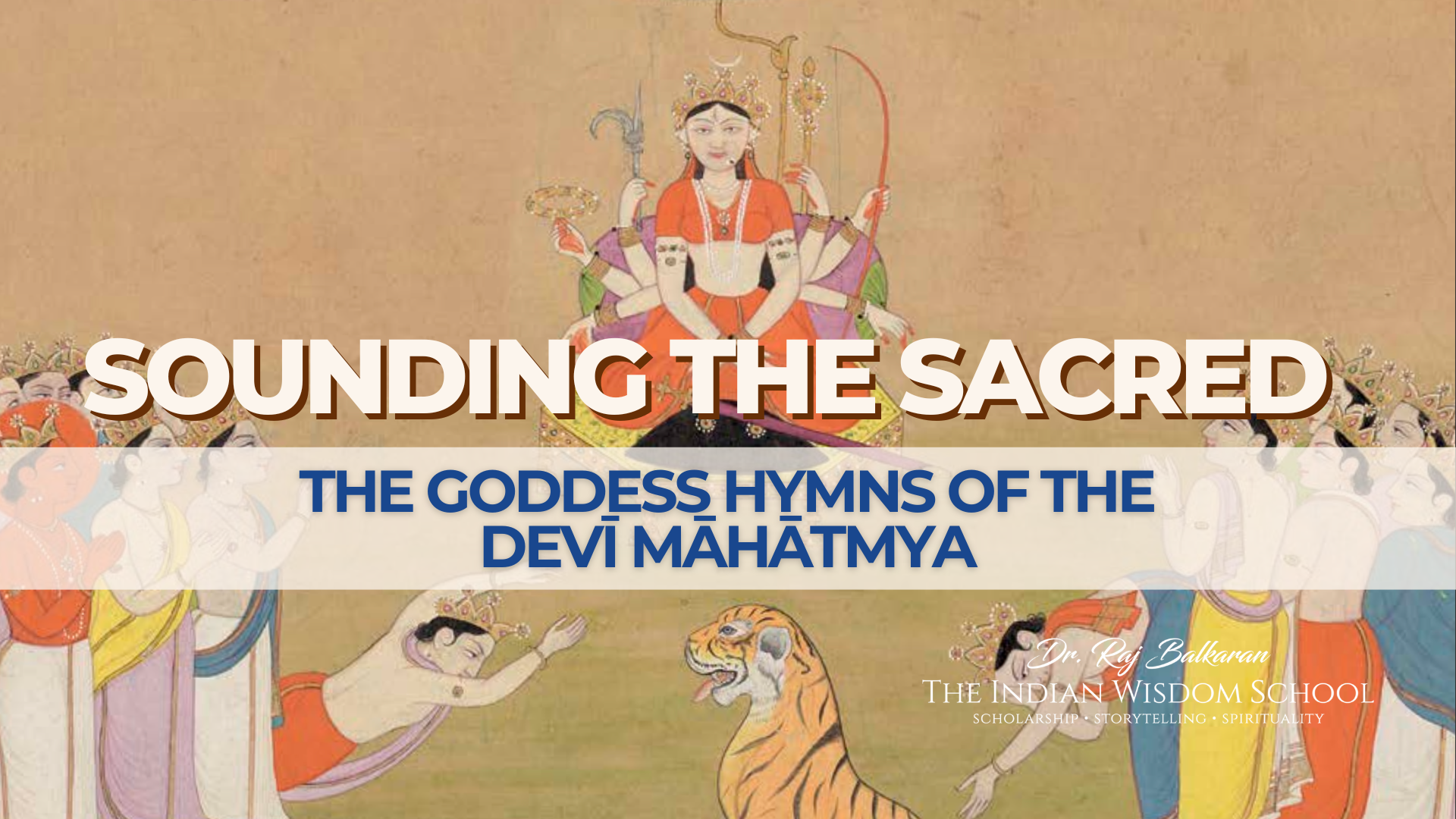
Sounding the Sacred:
The Goddess Hymns of the Devī Māhātmya
The Devī Māhātmya's four great hymns, read line by line — a course on the Goddess who abides in sacred utterance.
Why do the gods praise the Goddess?
What vision of reality does their praise proclaim?
How does voiced praise manifest the Goddess?
For over a thousand years, the Devī Māhātmya has been chanted across the Indic world to summon the grace of the Goddess. Of its seven hundred verses, its four hymns rise above the rest — praises so potent that tradition lifts them out of the narrative to be recited on their own in the form of the Brahmā Stuti, the Śakrādi Stuti, the Aparājitā Stuti, and the Nārāyaṇī Stuti. Millions know them by heart, yet far fewer know their context, their significance and their power. This course addresses just that.
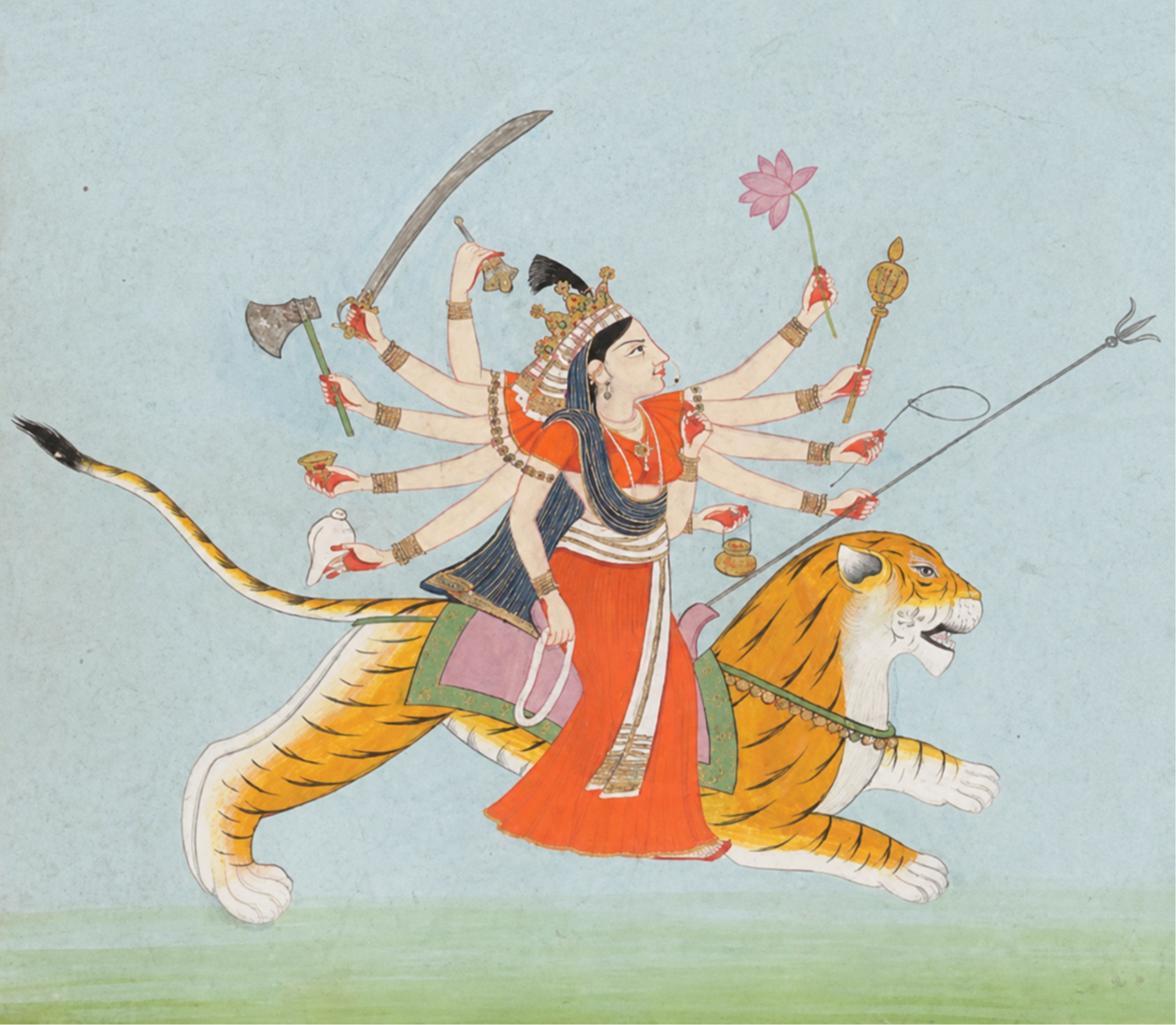
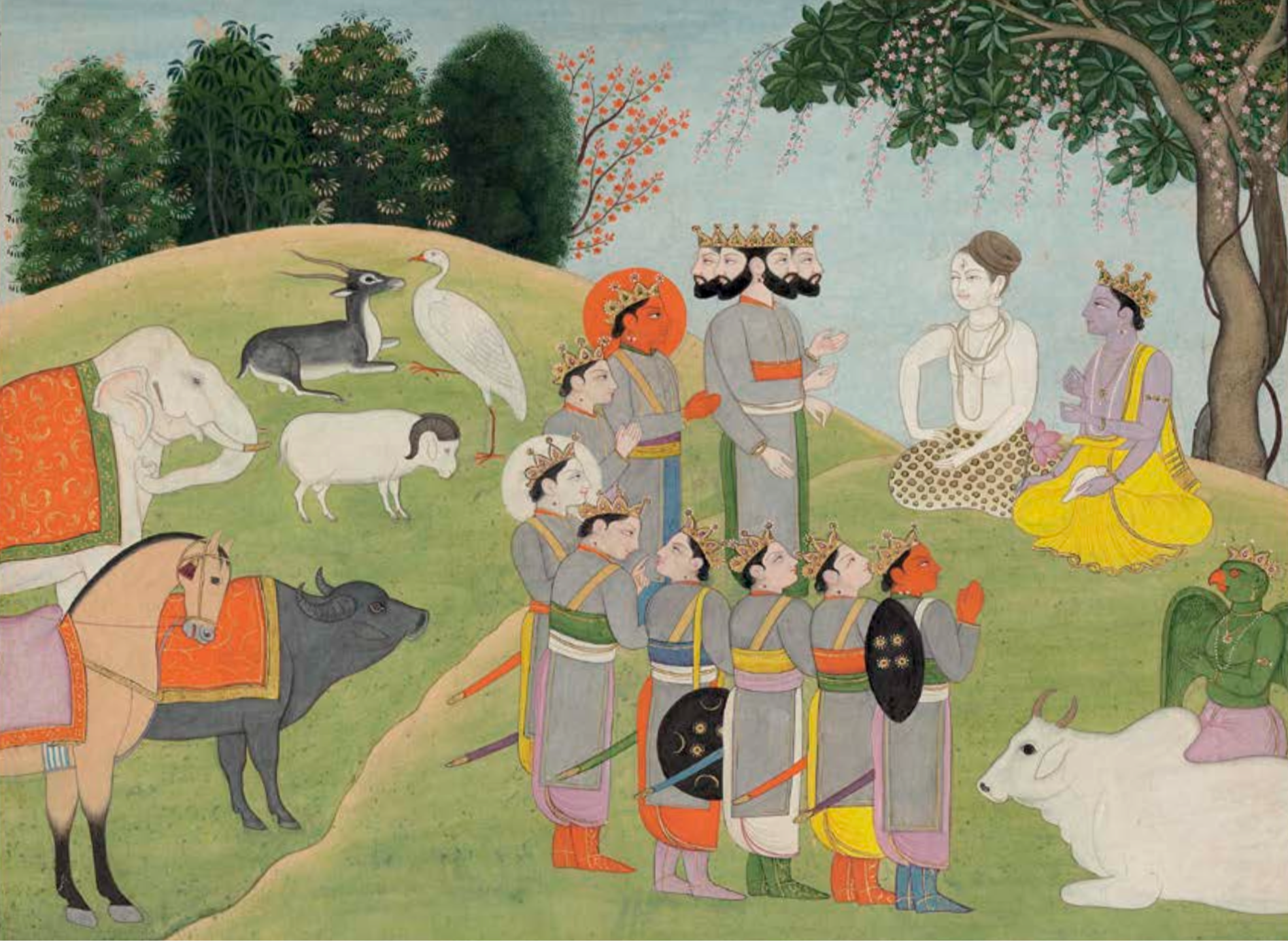
Rather than reading the Devī Māhātmya as a battle-text — three episodes, three demon-armies, three Goddess triumphs — in which the hymns are devotional interludes, this course inverts that picture, treating the hymns as the very engine of the text.
What the hymns proclaim is as remarkable as what they accomplish. In praising the Goddess, the gods establish a cosmos with feminine ground — the Goddess as primordial substrate prior to Hari and Hara. She is sound itself in the form of the chanted Vedas and beyond. She is the very consciousness, mercy, and power alive within every being. These praises do not merely glorify her: they advance a compelling vision of reality, one sounded rather than argued.
Beneath all four hymns lies a single claim: that the Goddess is śabdātmikā — sound-natured, sound-bodied. She does not merely receive praise but abides as sound and sounding, and abides in the world only so long as she is voiced — which is why the hymns you will study are the very ones still recited in temples and home shrines today. To learn them is not to study a relic, but to enter the unbroken chain of voicing that partakes in her presence.
Across these four course modules — focusing on one hymn each — we read every line: every epithet, every refrain, every act of naming. The aim is not to lecture about the hymns but to experience them, following a single thread from the first voice to the last: from Brahmā alone at the dawn of the cosmos, to the exultant chorus of the gods, to the presence of the Goddess upon your own lips.
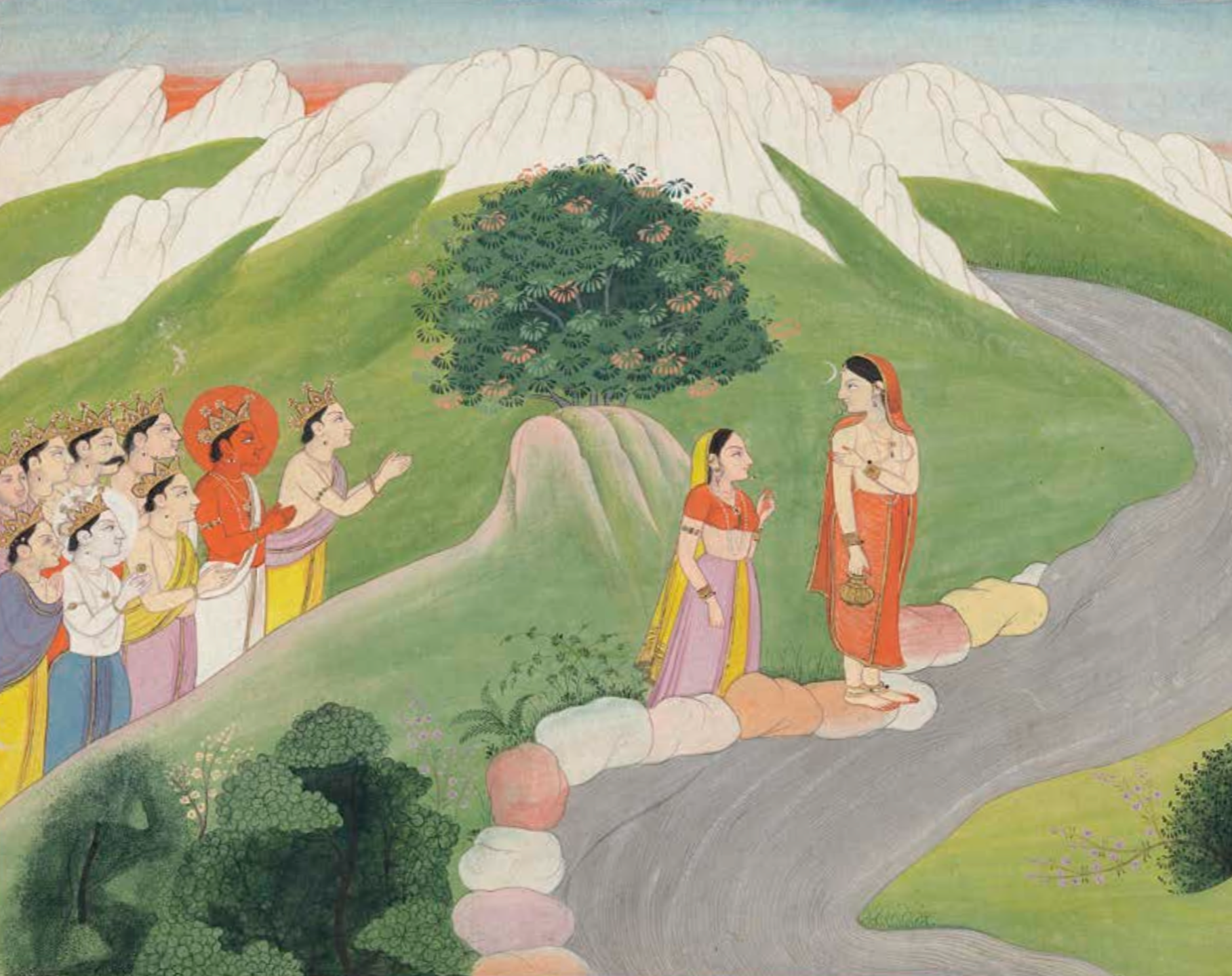
This course is for anyone who has ever chanted — or longed to chant — the hymns of the Goddess in the Devī Māhātmya, and wishes to know what they mean, what they do, and why they have been voiced for centuries unbroken.
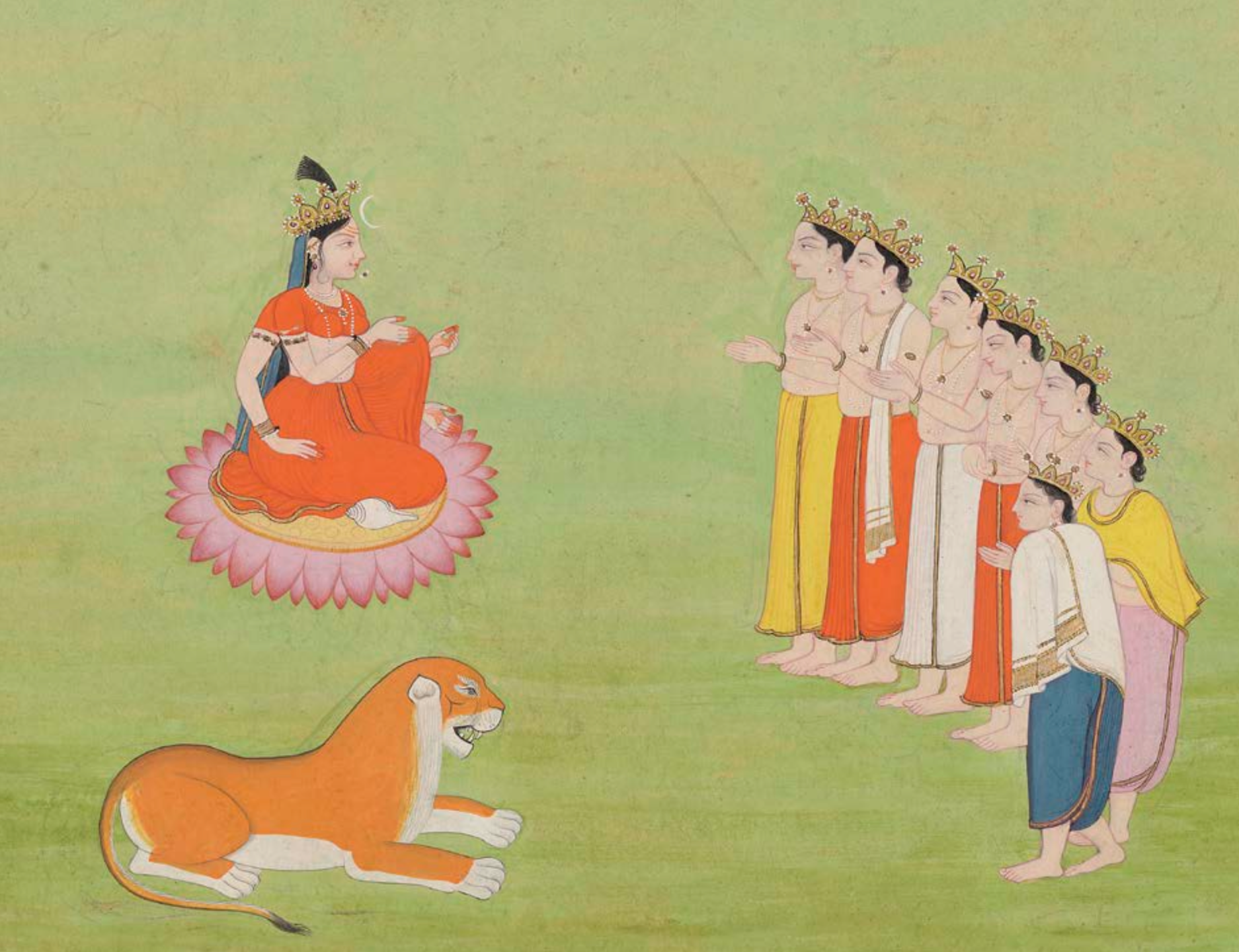
In this course, you will explore:
- The four great hymns (stutis) of the Devī Māhātmya, read line by line
- The theology of śabda — sacred sound — and the Goddess as sound itself
- The vision the hymns advance: the feminine as the ground of all that is
- How praise functions: petition and thanksgiving, summons and consummation
- The beloved yā devī sarvabhūteṣu litany — and why repetition is its own form of power
- Sanskrit epithets, refrains, and the inner architecture of each hymn
- The Goddess's self-prophecy — the single place she speaks in her own voice
- How these hymns pass from the page into the living Caṇḍī Pāṭha chanted today
The four hymns trace one arc — from the Goddess asleep at the dissolution of the worlds to the Goddess abiding in every voice that incants her holy name. Cosmic slumber to cosmic awakening, across four hymns.
Course Structure
Module 1 — The Creator's Call: The Power of Sleep
Module 2 — Indra's Exultation: The Voice of Victory
Module 3 — Abiding in All: The Power of Presence
Module 4 — The Royal Refuge: The Power of Prophecy
Learning Outcomes
By the end of this course, students will be able to:
- Identify the four hymns (stutis) of the Devī Māhātmya and their place within its narrative and liturgical architecture.
- Read each hymn closely — its epithets, refrains, and internal structure — in translation and in its key Sanskrit terms.
- Articulate the theology of śabda: how the Devī Māhātmya understands the Goddess as sound itself.
- Interpret the vision the hymns advance: the feminine as primordial prakṛti and the ground of all that is.
- Distinguish the work each hymn performs — petition and thanksgiving, summoning and consummation.
- Explain how the yā devī sarvabhūteṣu litany makes repetition a form of recognition and immanence.
- Analyze the Goddess's self-prophecy as the text's pivot from being-praised to speaking in her own voice.
- Trace the movement from the hymns within the text to the living Caṇḍī Pāṭha recited today.
- Recognize the Devī Māhātmya not as an object of study but as a practice — sound that makes the sacred present.
Sacred Sound in an Age of Noise
Ours is a moment overtaken by noise — a world in which the most amplified voice claims authority, speech is weaponized, and attention is captured and sold. The Devī Māhātmya knows this adversary intimately, for the demon Mahiṣa, too, ruled by bellowing. Against the roar of domination, the hymns set a wholly different relation to sound: sound as summons, sound as recognition, sound as the act by which the sacred is called into presence. In an age that mistakes volume for power, they recover the older truth — that what is given voice is what is called into being.

10+ Hours of Video Lessons
Valuable for the simply curious, longtime yogis, expert practitioners and everyone in between

Downloadable Notes
Easily follow along with and refer back to the class slides

Access Anytime, Anywhere
Whether day or night, wherever you are, you have forever access to this on-demand course

Ancient Wisdom, Modern Applications
Learn mantra and other techniques to apply teachings to your life

Join The Indian Wisdom School
Become a part of our community and gain access to exclusive events and lessons

Yoga Alliance Credit
This course counts as 10 hours of YA Continuing Education Credit

"I first came across Dr. Balkaran through his work with the Oxford Centre for Hindu Studies and have since taken a number of courses with him, all of which have been fabulous. Dr. Balkaran has a gift for synthesizing complex information and teaches with a storytelling style that supports comprehension."
Natalie Rousseau
Yoga Educator

"Dr. Balkaran is a teacher who understands the needs and quests of today’s spiritual seekers and practitioners and his School is a unique and a much-awaited opportunity for any interested-minded students to access the complex realm of the Indian philosophy and mythology explained in an approachable and engaging manner."
Aijan Kenenbaeva
Yoga Practitioner and Hinduism Student

"As a graduate student in the blossoming field of Yoga Studies, I cannot express the proper gratitude for Dr. Raj and his method of mystical swagger. He has tremendously assisted my personal understanding of inherently foreign concepts embedded within Indian wisdom and myth."
Dustin Nicholas Holmes
Naropa University, Wisdom Traditions
M.A. Yoga Studies

"I have greatly enjoyed taking Dr. Balkaran’s online classes! His style of presenting content is a rich synthesis of rigorous academic scholarship and his own experiential insights which add depth, humor and clarity to the often misconstrued concepts of Indian mythology."
Srinalini Sankar
French Teacher and Lifelong Student


Meet Your Instructor
Dr. Raj Balkaran is the founder of The Indian Wisdom School and a scholar of Sanskrit literature specializing in the Devī Māhātmya. He holds a doctorate in Religious Studies, serves as a Continuing Studies Tutor at the Oxford Centre for Hindu Studies, and is the author of two academic monographs on this very text — including The Goddess and the King in Indian Myth: Ring Composition, Royal Power, and the Dharmic Double Helix. He is the author of the popular The Stories Behind the Poses — with over 35,000 copies sold — hosts the New Books in Indian Religions podcast, and has been interviewed by the BBC, CBC, and other major media as a public intellectual on Indian wisdom traditions.
Alongside his academic career, Dr. Balkaran was initiated into Indian wisdom traditions by multiple lineal teachers and spent over a decade in apprenticeship with a renowned spiritual master. What he brings to this course is the fruit of over twenty years of daily practice, academic study, recitation, initiation, and spiritual contemplation — the Glories of the Goddess not merely as object of study, but as living wisdom much needed for our modern moment.