

Seeing the Sacred:
The Goddess Meditations of the Devī Māhātmya
The Devī Māhātmya's four meditation-forms, read line by line — a course on the Goddess as she is beheld.
How is the Goddess made visible?
What is a reciter doing when she installs a form before she speaks?
How does an ancient image become a living presence on the tongue today?
For over a thousand years, before chanting a single verse of the Goddess's deeds, reciters of the Devī Māhātmya have first paused to see her. This is the work of the dhyānam — the meditation-verse set at the threshold of each of the text's three great movements, a single densely-wrought stanza that builds the Goddess before the mind's eye: her radiance, her lion, the weapons in each of her many hands, the very gesture of her fingers. Millions chant these verses daily; far fewer know how they are made, where their imagery comes from, or what they accomplish. This course addresses exactly that.
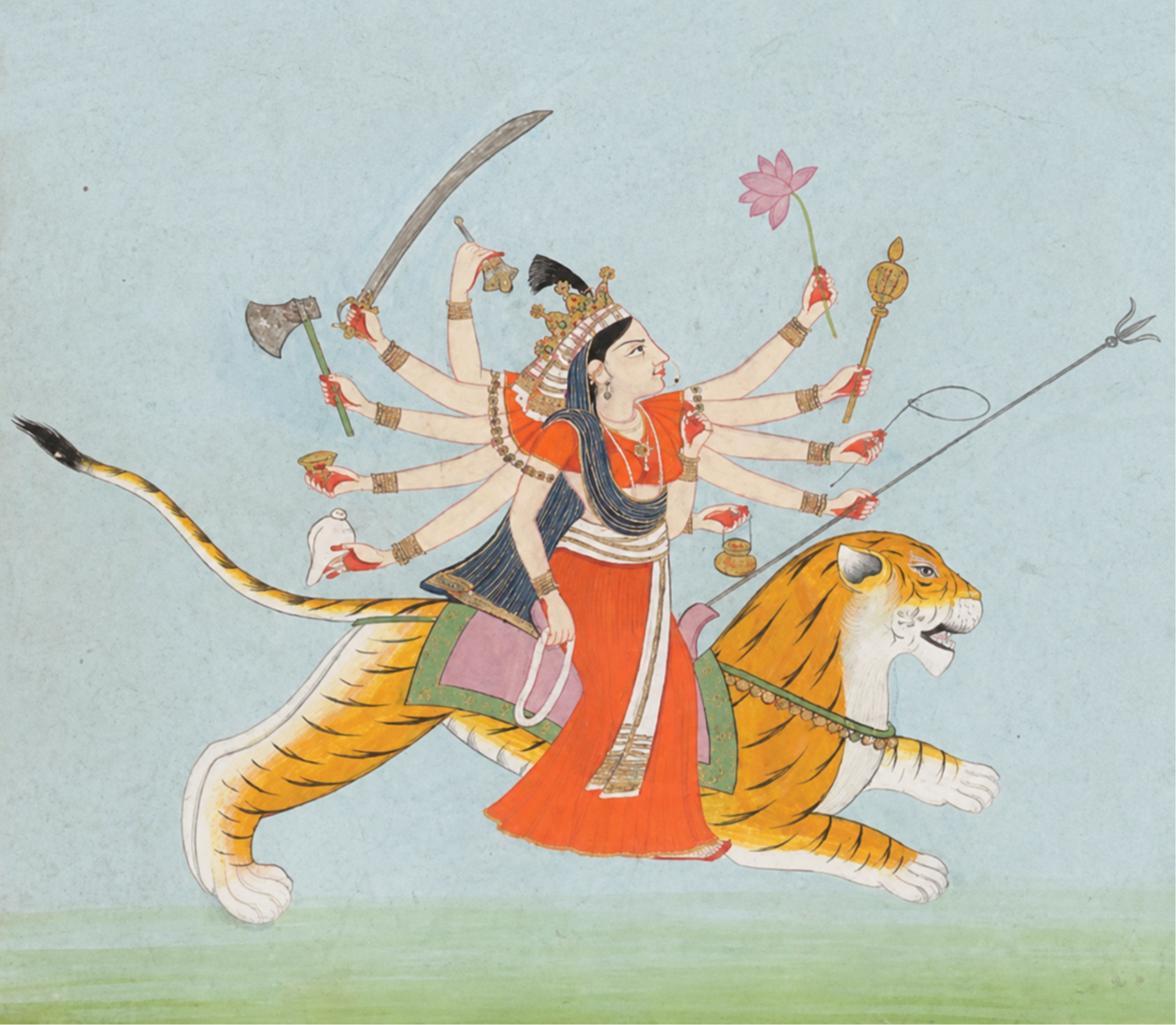
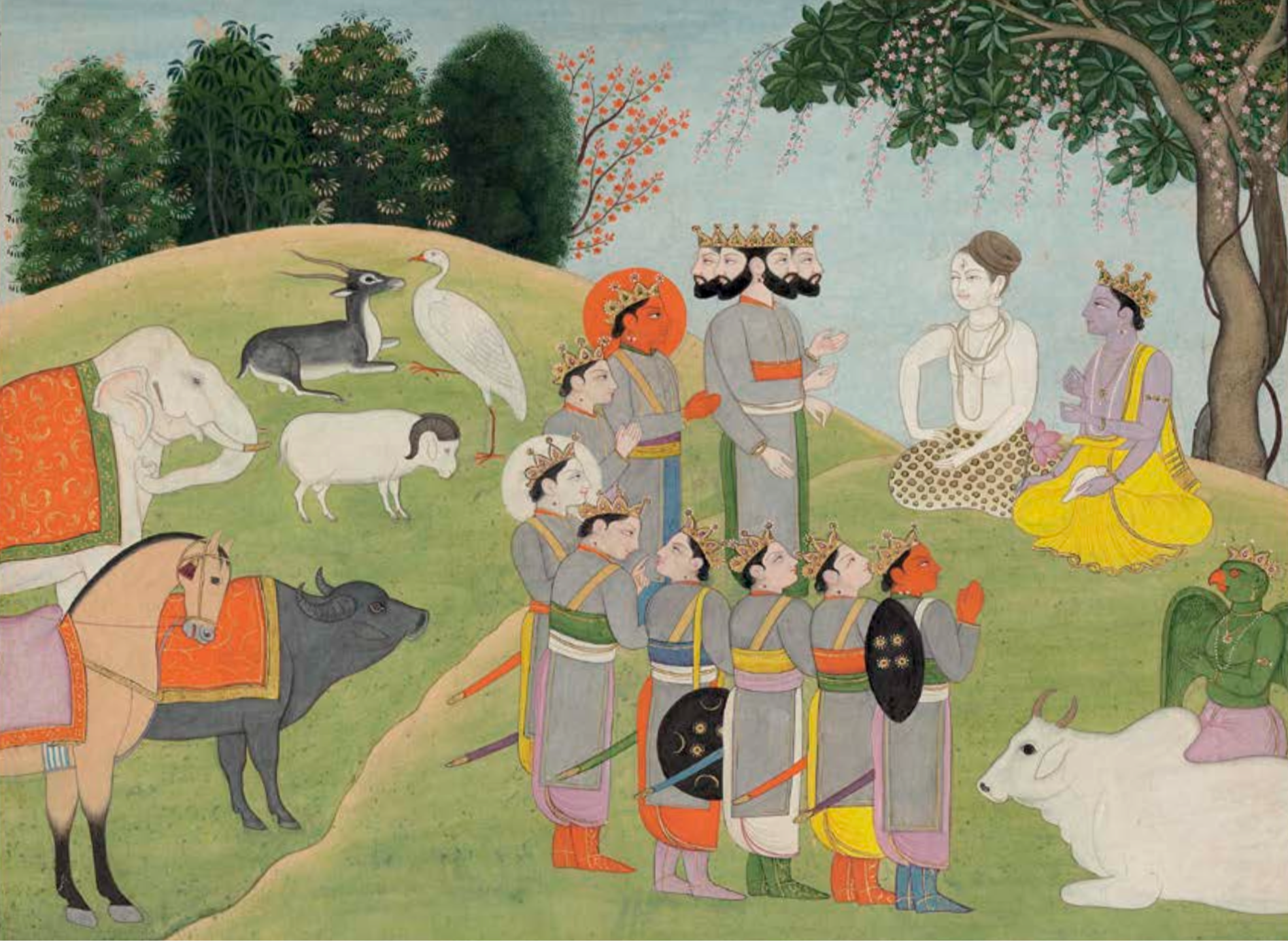
There are three meditations proper — one for each episode — and a fourth that frames them all: the supreme form of Durgā, radiant as lightning and throned upon her lion, in whom every power is held integral before any single power is loosed. Together these four are the seen counterpart to the text's four hymns. If the stutis are the Goddess as she is heard, the dhyānams are the Goddess as she is beheld — sound and sight, the two hands by which the sacred is made present.
The Third of a Trilogy
This course completes a three-part journey through the Devī Māhātmya, each course entering the same text by a different door:
- Glory to the Goddess — its story: the three episodes as a map of consciousness and its liberation.
- Sounding the Sacred — its voice: the four hymns, the Goddess as sacred sound.
- Seeing the Sacred — its vision: the four meditation-forms, the Goddess as beheld.
Story, voice, vision — three ways into one Goddess. Each course stands complete on its own; together they are the whole of how the Devī Māhātmya narrates, praises, and envisions her. Students of the first two will find this the culmination; newcomers need no prior course to begin.
This course is for anyone who has ever chanted — or longed to chant — the hymns of the Goddess in the Devī Māhātmya, and wishes to know what they mean, what they do, and why they have been voiced for centuries unbroken.
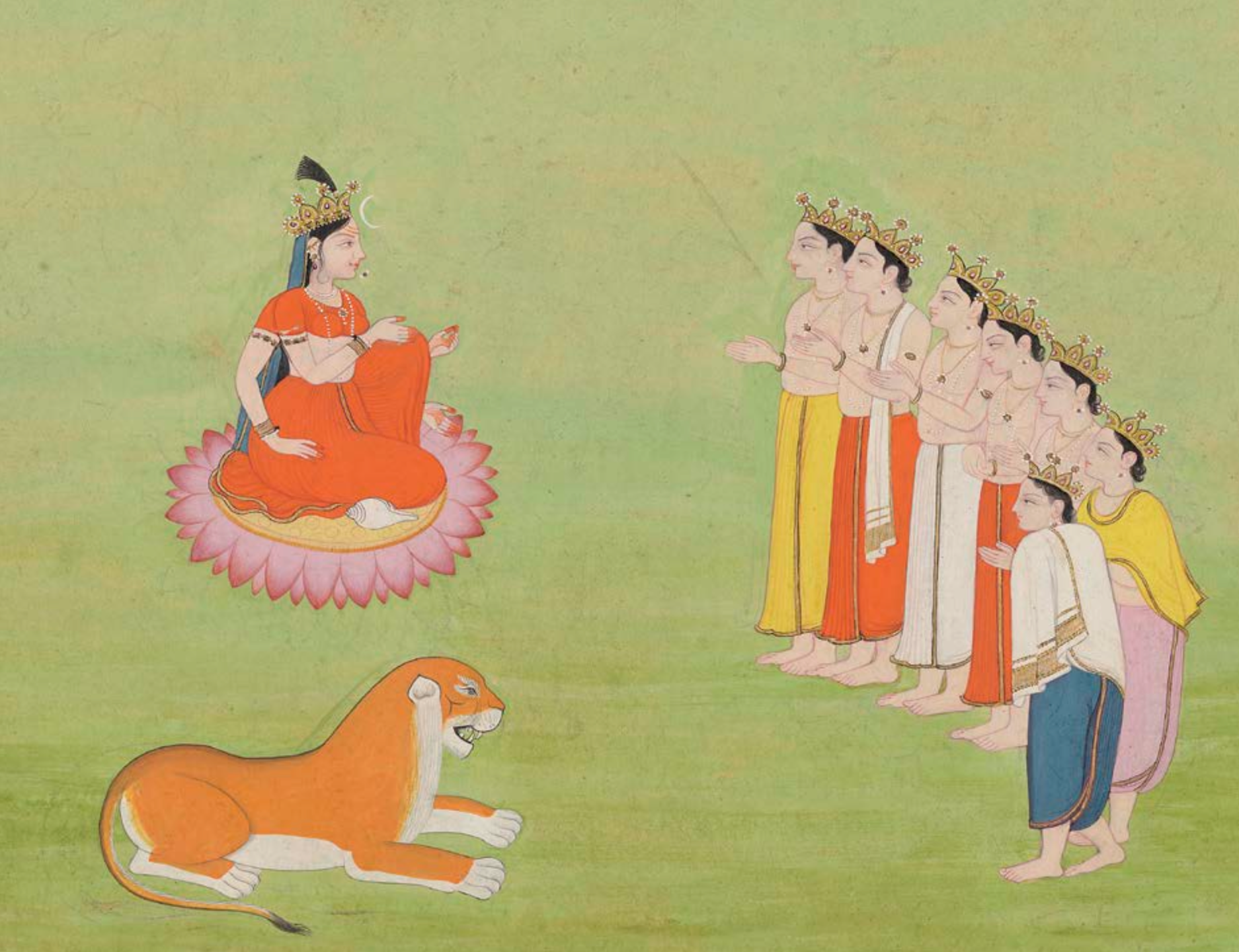
In this course, you will explore:
- The four meditation-forms (dhyānams) of the Devī Māhātmya, read line by line
- What a dhyānam is, and how visualization functions in recitation and practice
- How each form is drawn from its episode — the weapons in her hands as the very gifts of the gods
- The framing form of Durgā, and why she is the whole from which the three arise
- The three Goddesses as the highest powers of dissolution, sovereignty, and discrimination
- The guṇas raised to their apex — tamas, rajas, sattva as sovereign powers, not bindings
- How the dhyānams hand the Goddess forward — from the ancient story into the living Caṇḍī Pāṭha
- The meditation-forms as the very practice of Navarātri, read as they are meant to be used
The four forms trace one arc — from the integral Goddess who holds all power, through her three great differentiations, to the discovery that the many were always the One. Wholeness, dissolution, sovereignty, discrimination — across four meditations.
Course Structure
Module 1 — Durgā: The Integral Form
Module 2 — Mahākālī: The Withholding Dark
Module 3 — Mahālakṣmī: The Gathered Splendor
Module 4 — Mahāsarasvatī: The Discerning Light
Learning Outcomes
By the end of this course, students will be able to:
- Identify the four meditation-forms (dhyānams) of the Devī Māhātmya and their place within its narrative and liturgical architecture.
- Explain what a dhyānam is — how visualization functions in recitation, and how the seen form and the act of worship are fused.
- Read each meditation closely — its radiance, arsenal, mount, and gesture — in translation and in its key Sanskrit terms.
- Interpret the guṇa-scheme the forms embody: tamas, rajas, and sattva raised to their apex as the sovereign powers of dissolution, sovereignty, and discrimination.
- Distinguish the three Goddesses — Mahākālī, Mahālakṣmī, Mahāsarasvatī — by form, power, and the deed each governs.
- Analyze the framing form of Durgā as the integral whole from which the three differentiate.
- Trace how each dhyānam draws its imagery from its episode — the weapons in the Goddess's hands as the gifts of the gods.
- Follow the movement from the meditation-forms within the text to the living Caṇḍī Pāṭha recited today, above all at Navarātri.
- Recognize the Devī Māhātmya not as an object of study but as a practice — a discipline of beholding that makes the sacred present.
Sacred Sight in an Age of Images
Ours is a moment drowning in images — a scroll of them, endless, engineered to capture the eye and sell the attention it captures. We are seen more than we see, and what we look at is chosen for us. The Devī Māhātmya knows a wholly different relation to the image. The dhyānam is not an image consumed but an image built — slowly, deliberately, by the one who beholds — and built not to capture the seer but to install a presence worthy of reverence. Against a visual world that takes, the meditation-form gives: it asks the practitioner to become the maker of what she sees, and to see, in the end, the sacred. In an age that looks without beholding, the dhyānams recover the older art — that to truly envision is a discipline, and a devotion.
Pre-Recorded Modules Released
Thursdays
- Module 1 Sep 17, 2026
- Module 2 Sep 24, 2026
- Module 3 Oct 1, 2026
- Module 4 Oct 8, 2026
Live Zoom Tutorial
Optional | Recordings Provided
Thursdays @ 9am-10am EDT
- Tutorial 1 July 2, 2026
- Tutorial 2 July 9, 2026
- Tutorial 3 July 16, 2026
- Tutorial 4 July 23, 2026

10+ Hours of Video Lessons
Valuable for the simply curious, longtime yogis, expert practitioners and everyone in between

Downloadable Notes
Easily follow along with and refer back to the class slides

Access Anytime, Anywhere
Whether day or night, wherever you are, you have forever access to this on-demand course

Ancient Wisdom, Modern Applications
Learn mantra and other techniques to apply teachings to your life

Join The Indian Wisdom School
Become a part of our community and gain access to exclusive events and lessons

Yoga Alliance Credit
This course counts as 10 hours of YA Continuing Education Credit

"I first came across Dr. Balkaran through his work with the Oxford Centre for Hindu Studies and have since taken a number of courses with him, all of which have been fabulous. Dr. Balkaran has a gift for synthesizing complex information and teaches with a storytelling style that supports comprehension."
Natalie Rousseau
Yoga Educator

"Dr. Balkaran is a teacher who understands the needs and quests of today’s spiritual seekers and practitioners and his School is a unique and a much-awaited opportunity for any interested-minded students to access the complex realm of the Indian philosophy and mythology explained in an approachable and engaging manner."
Aijan Kenenbaeva
Yoga Practitioner and Hinduism Student

"As a graduate student in the blossoming field of Yoga Studies, I cannot express the proper gratitude for Dr. Raj and his method of mystical swagger. He has tremendously assisted my personal understanding of inherently foreign concepts embedded within Indian wisdom and myth."
Dustin Nicholas Holmes
Naropa University, Wisdom Traditions
M.A. Yoga Studies

"I have greatly enjoyed taking Dr. Balkaran’s online classes! His style of presenting content is a rich synthesis of rigorous academic scholarship and his own experiential insights which add depth, humor and clarity to the often misconstrued concepts of Indian mythology."
Srinalini Sankar
French Teacher and Lifelong Student


Meet Your Instructor
Dr. Raj Balkaran is the founder of The Indian Wisdom School and a scholar of Sanskrit literature specializing in the Devī Māhātmya. He holds a doctorate in Religious Studies, serves as a Continuing Studies Tutor at the Oxford Centre for Hindu Studies, and is the author of two academic monographs on this very text — including The Goddess and the King in Indian Myth: Ring Composition, Royal Power, and the Dharmic Double Helix. He is the author of the popular The Stories Behind the Poses — with over 35,000 copies sold — hosts the New Books in Indian Religions podcast, and has been interviewed by the BBC, CBC, and other major media as a public intellectual on Indian wisdom traditions.
Alongside his academic career, Dr. Balkaran was initiated into Indian wisdom traditions by multiple lineal teachers and spent over a decade in apprenticeship with a renowned spiritual master. What he brings to this course is the fruit of over twenty years of daily practice, academic study, recitation, initiation, and spiritual contemplation — the Glories of the Goddess not merely as object of study, but as living wisdom much needed for our modern moment.